While you wait

A little coffee run

00%
Brewin’Ready!
Work 0 percent loaded

I lead design for corporate and institutional banking platforms: the web and mobile products clients work in, the API marketplace developers build against, and the tools on the trading floor.

I work on the practice as much as the products, through shared design standards, career paths for designers, and getting design, product and engineering closer together.

Twenty years in — an agency of my own in Tokyo, then the last decade in Singapore banking — I still hold to the same brief: simplicity, beauty, function.

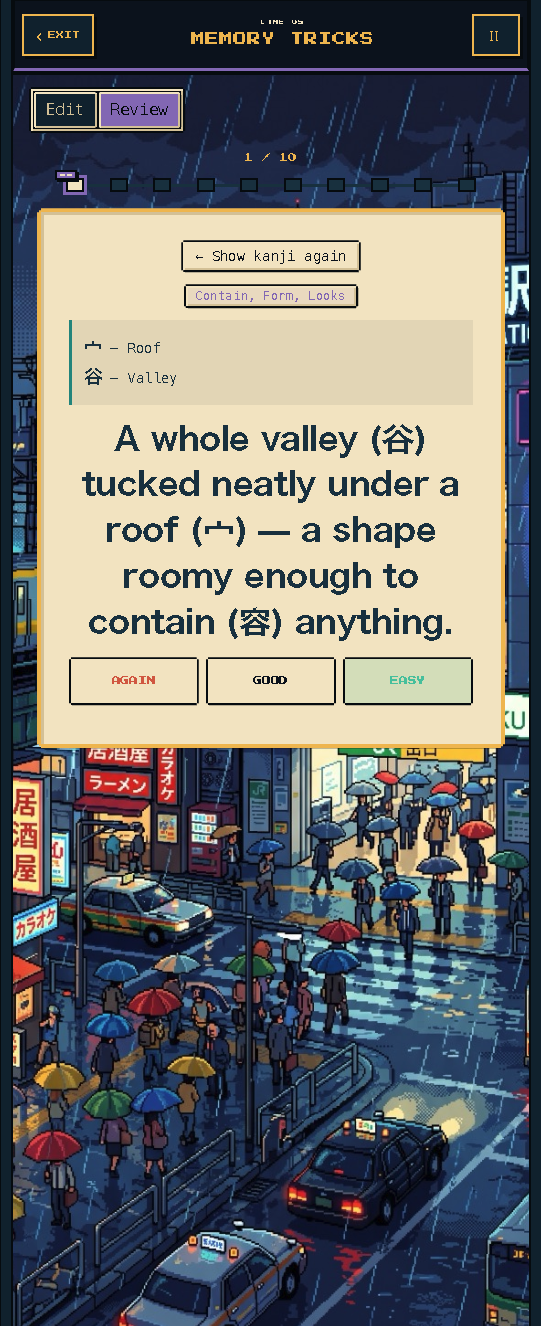
Memory Tricks kanji lesson in a rainy pixel-art city

Building
with AI

In my personal projects, I use AI as a way to learn by making. Kanji is a study you don’t finish, and I’m still at it, so I built the app I wanted for it: AI from the ground up, an 8-bit aesthetic, sized for a commute.

Underneath it are three agents that check, verify and structure the learning content. Lately I’ve been running several in parallel: on the app, on software for my wife’s bakery, and on this site.

The fastest way to understand a tool is to build something playful with it first. MCP, agents and APIs, learned by building this site.

I’m not shipping these personal projects to any schedule; my goal is to learn and explore, following interesting problems to solve instead of urgent ones, with AI teaching me as I go. Building this way has changed how I think about the process, and my role as a design leader.

Continuous feedback

Design process01—05

The double diamond becomes a continuous diamond.

It was drawn at a time when code used to be poured concrete—expensive and rigid. Today, it behaves like clay, where building is often the fastest way to discover what shape a product should actually take.

I saw this firsthand while developing a Kanji app for my personal Japanese study. I studied language app learning and design patterns, studied memorisation techniques and best practices, then built a rapid prototype of the app. Weekly feedback—from my teacher, classmates, and wife, alongside AI agents challenging my assumptions—turned discovery, design, and engineering from rigid sequential phases into a continuous, living rhythm.

Working with AI introduced a new friction: while it happily generates valid designs, it frequently bloats scope with unnecessary extras. In the end, I got a tighter result designing by hand in Figma, then pulling it into VS Code via MCP to refine.

Now that anyone can generate anything, AI easily produces competent, average work. What separates a great product from an automated one isn’t speed—it’s taste and craft.

Taste is knowing what a problem actually needs and what to leave out, while craft is the fluency to execute that choice with excellence. True taste can’t be automated; it is earned through years of practicing the craft.

Community & Craft

Outside of work, my wife and I volunteer in our local community. From park and beach clean-ups to neighbourhood events, we’re there to lend a helping hand.

For fourteen years I’ve organised and hosted PechaKucha Night Singapore, a casual and fun evening community event with one rule: 20 slides, 20 seconds each. We’ve had the pleasure of hosting a number of local famous names on that stage, alongside entrepreneurs, urban planners, architects and guitar techs.

Time away from the screen

Let’s start a
conversation

For collaborations, speaking and thoughtful conversations.

Connect on LinkedIn